
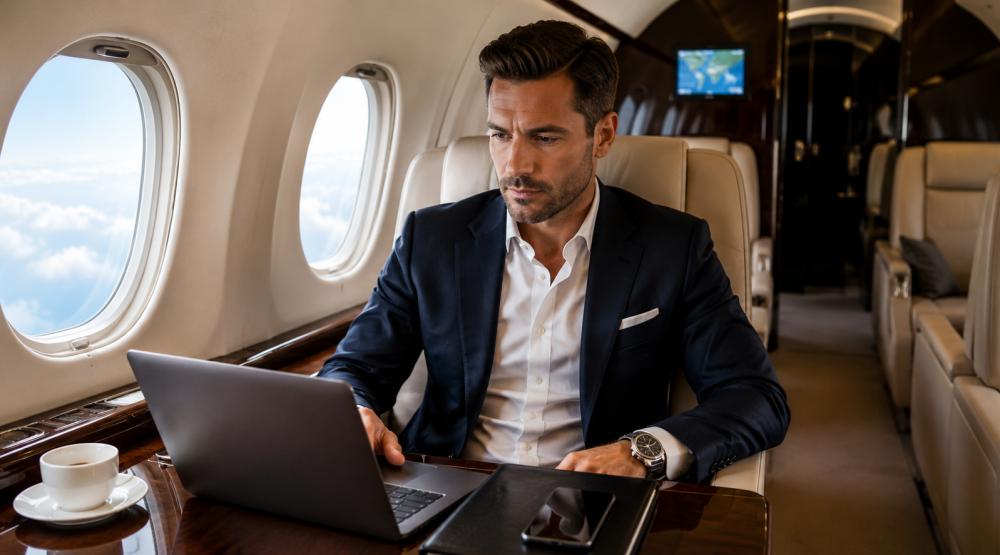
For many executives, founders, and high-performing teams, travel is no longer just about getting from one city to another.
It is about time, control, privacy, and productivity.
That is why the comparison between private jet vs first class is not as simple as looking at the ticket price. First class may offer a better seat. Private aviation changes the entire travel experience.
For business travelers who operate on tight schedules, manage sensitive conversations, or need to move efficiently between cities, private jet charter can deliver value far beyond comfort.
First Class Improves the Seat. Private Aviation Improves the Schedule.
First class can make commercial travel more comfortable, but it does not solve the biggest issue with airline travel: lack of control.
You are still operating on the airline’s schedule. You are still moving through the same airport system. You are still subject to delays, cancellations, boarding procedures, baggage timelines, and airport congestion.
With a private charter flight, the schedule is built around the traveler.
That difference matters.
- You choose the departure time
- You fly closer to your destination
- You avoid crowded terminals
- You reduce wasted time before and after the flight
- You create a more controlled travel environment
The Real Cost Is Often Time
When comparing private jet charter cost to first class, many people focus only on the flight price.
But for executive travel, the larger question is this: what is the cost of lost time?
A commercial flight may appear less expensive, but the full travel day often includes early airport arrival, security lines, boarding delays, taxi time, baggage claim, ground transfers, and schedule limitations.
For a business leader, legal team, investor, or executive group, those hours are not neutral. They carry value.
Private aviation allows travelers to recover time that would otherwise be lost inside the commercial system.
Productivity Changes in the Air
First class provides space to sit. A private aircraft provides space to work.
For executives and leadership teams, the private cabin can function as a meeting room, planning space, or secure extension of the office. Sensitive conversations can happen without concern for surrounding passengers. Documents can be reviewed. Calls can be made. Decisions can continue moving forward.
For many business travelers, that is one of the most important advantages of private aviation for business travel.
The flight does not interrupt the workday. It becomes part of it.
Same-Day Travel Becomes More Realistic
One of the clearest advantages of private charter is the ability to complete trips that are difficult or impossible through commercial airlines.
A morning meeting in one city and dinner back home the same evening may not be realistic with traditional airline schedules. With private aviation, it often is.
We explored this in more detail in our article Dallas to Palm Beach in a Day: How Private Jet Charter Makes Same-Day Travel Possible.
For executives balancing business obligations, family commitments, and tight timelines, this kind of flexibility can change how travel is planned altogether.
Privacy Is Not a Perk. It Is a Business Advantage.
In first class, privacy is limited.
You may have a larger seat, but you are still surrounded by other passengers, crew traffic, and a public travel environment. For high-level business conversations, legal discussions, acquisition planning, or confidential client matters, that is not ideal.
Private aviation provides a controlled environment.
That matters for:
- Executive leadership teams
- Legal and financial professionals
- Public-facing individuals
- Family offices and private advisors
- Companies managing sensitive transactions
When discretion matters, private charter offers a level of separation commercial travel cannot match.
Group Travel Can Shift the Value Equation
For one traveler, first class may seem more economical.
For several travelers moving together, the comparison changes.
When a leadership team, board group, production crew, athletic staff, or client group needs to travel together, group charter flights can simplify logistics and improve coordination.
Instead of booking multiple commercial itineraries, managing different arrival times, and coordinating separate ground transportation, the group moves together on one schedule.
That creates efficiency before, during, and after the flight.
What About Price Transparency?
Private aviation pricing can vary widely based on aircraft type, flight distance, operator availability, fuel, crew requirements, and airport costs.
That is why the structure of the quote matters.
The lowest number is not always the strongest option, especially if the final invoice includes unexpected charges. Fuel adjustments, repositioning costs, and contract terms can all affect the final private charter price.
For more on this, read Why Am I Receiving a Post-Flight Fuel Surcharge Invoice?.
When First Class Still Makes Sense
First class still has a place.
For simple routes, flexible schedules, solo travelers, and trips where timing is not critical, commercial premium travel may be a practical choice.
But once the trip involves multiple people, tight windows, confidential work, limited airport access, or same-day return needs, private aviation becomes much more compelling.
The Bottom Line
The debate between private jet vs first class is not really about luxury.
It is about control.
First class improves the commercial travel experience. Private aviation removes many of the limitations that make commercial travel inefficient in the first place.
For executives, business owners, and organizations that value time, privacy, and flexibility, private charter can be the smarter business decision.
If you are evaluating whether private aviation makes sense for your next business trip, contact Leading Edge Investments to discuss the mission and explore the right charter solution.